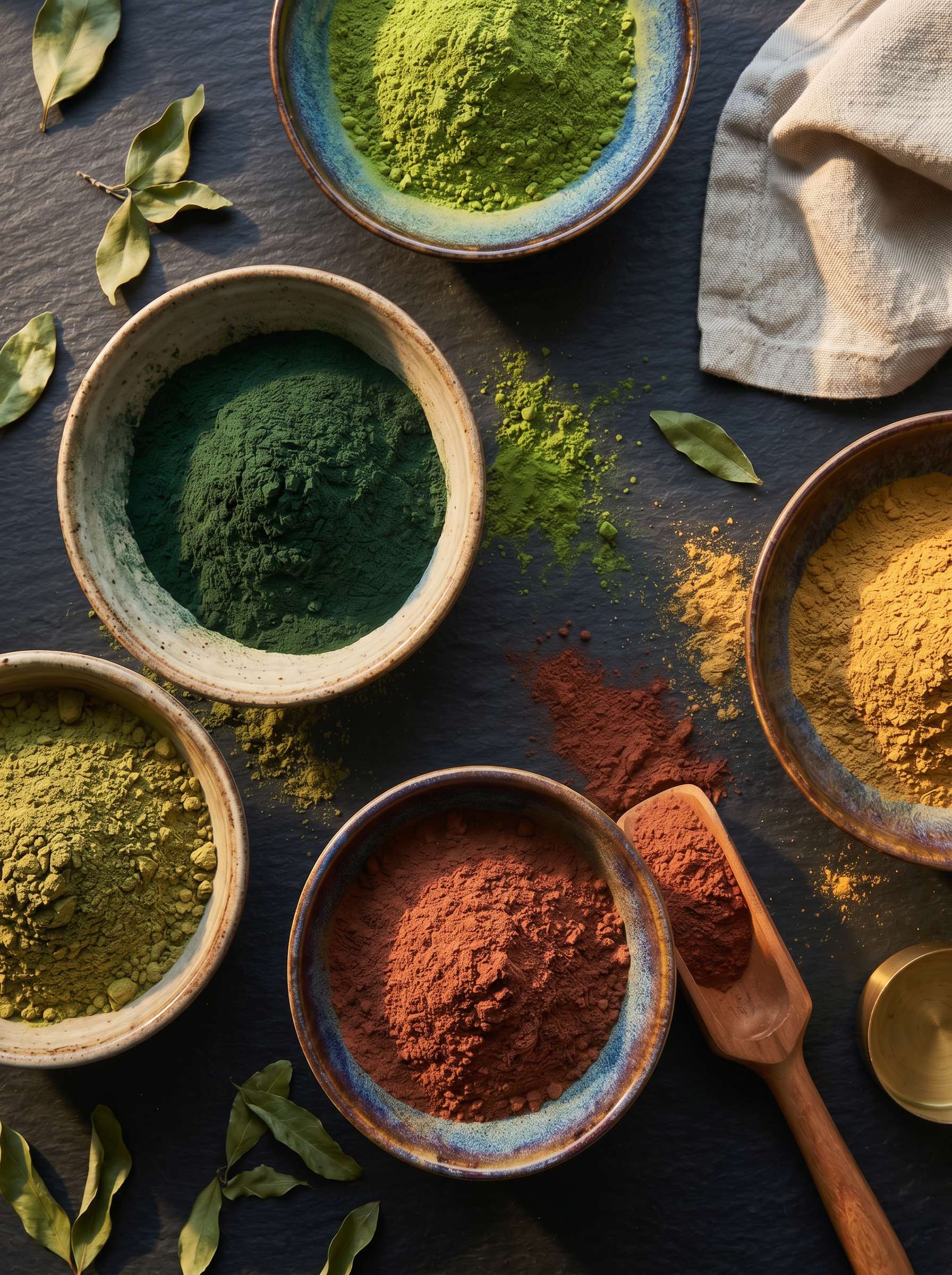
Kratom comes in several formats and each one has its own rhythm. If you're new, the range can feel a little overwhelming — powder, capsules, tea cut, extracts, sometimes tinctures and shots — and it isn't always obvious which to try first or how to actually prepare them. This article is a practical walkthrough, format by format, with the honest trade-offs.
A note on scope: for the right amount in each format, see the dosage guide. The focus here is on the mechanics of preparation and what to expect from each method.
Loose powder
Finely ground dried leaf. The most common, most versatile, and lowest cost per gram of any format. The base material that most other formats are built from.
The "toss-and-wash"
The bluntest method, and probably the most widely used. You measure your serving into a spoon or the cap of a bottle, tip it into your mouth, and immediately wash it down with a large sip of water, juice, or another liquid of your choice. The goal is to swallow the powder without letting it sit too long on the tongue. It's fast and uses no equipment, but the texture takes getting used to.
Tips that help: have your drink ready in hand, take a sip first to wet your mouth, then toss, then wash. Cold liquid is often easier than warm. Citrus juices mask the bitterness better than water.
Mixed into a liquid
Measure your serving into a glass or shaker, add about 8–12 ounces of liquid, stir or shake thoroughly, and drink. Kratom powder doesn't truly dissolve — it suspends — so you'll need to keep it moving as you drink to avoid a gritty last sip. Acidic juices (orange, grapefruit, cranberry) tend to cut the bitterness more effectively than water or milk.
This method is slower than toss-and-wash but easier on the palate. It's also more social — you can drink it like any other beverage.
Mixed into food
Some people mix powder into yogurt, applesauce, or a smoothie. This works fine, though the amount of carrier matters: a thick yogurt will mask the taste better than a thin smoothie. Eating kratom in food also means the serving is absorbed more slowly than on an empty stomach, softening the onset.
Capsules
Powder pre-measured into vegetable capsules, typically containing 500 mg each. A typical serving of 2 grams is 4 capsules; 3 grams is 6; 4 grams is 8. Simple arithmetic, though you do end up swallowing a noticeable amount of pills to reach a useful serving.
Trade-offs:
- Taste is eliminated. This is the main reason many people prefer capsules.
- Cost per gram is higher — usually noticeably. You're paying for the encapsulation work.
- Onset is slightly slower. The capsule needs to dissolve in your stomach before the powder is accessible. Plan on adding 10–20 minutes to the timing you'd expect from powder.
- Precision is fixed to 500 mg increments. You can't easily titrate to 2.3 grams; you'd have to open a capsule and split the contents.
Capsules are a reasonable starting point for people who know they'll dislike the taste of raw powder, and for anyone who wants a discreet, portable format.
Tea (steeped leaf)
Tea is the traditional way kratom was prepared in Southeast Asia — fresh leaves, simmered, and strained. The modern version uses the same idea with dried leaf or a coarser "tea cut," and it's worth trying at least once, both for what it's like as an experience and because it's the closest format to how the plant has been used for centuries.
Basic preparation
- Measure your serving — whether that's powder or tea-cut leaf — into a pot or French press.
- Add hot but not boiling water. Somewhere in the range of 170–185°F (77–85°C) is about right. A full rolling boil is too aggressive and can degrade some alkaloids.
- Steep for 10–15 minutes. Longer is usually fine; short is undershooting.
- Strain thoroughly — through a fine mesh strainer, a coffee filter, a cheesecloth, or the plunger of a French press. The solids end up in the strainer; the liquid is your tea.
- Drink warm, or chill and drink cold. Citrus, honey, or ginger all complement the flavour without interfering with the alkaloids.
What to expect
Because you're extracting a portion of the alkaloids into the water and discarding the rest with the solids, tea typically feels milder than the equivalent gram-weight taken as raw powder. A 4-gram tea is not a 4-gram toss-and-wash; plan for it to be on the gentler end. Onset tends to be faster (no solids to digest), and the duration is usually a touch shorter.
A practical tip many regular tea-drinkers use: add a small amount of acidic liquid (lemon juice, apple cider vinegar) to the simmer water. A mildly acidic extraction pulls more alkaloids out of the leaf than neutral water, bringing the tea's effective strength closer to a direct powder serving.
Concentrated extracts
Extracts are a different scale of product from anything above. The manufacturing process concentrates the alkaloids from a much larger amount of leaf into a smaller finished product, so servings are measured in small fractions of a gram, not in grams. A typical extract serving might be 0.2–0.5 grams, compared to 2–4 grams of powder.
A few formats you'll see:
- Extract powders — concentrated powder, often labelled by ratio (e.g., "10x") or by standardised alkaloid content.
- Extract capsules — small capsules containing concentrated powder.
- Liquid extracts and shots — concentrated liquid in small bottles, usually labelled with the milligrams of alkaloids per serving.
The most important rule with extracts: do not estimate by eye, and do not apply powder-sized servings to extracts. If you're used to taking a heaped spoonful of powder, the same volume of extract could be many times the intended serving. Use a scale that measures in fractions of a gram, start well below the typical extract range if you're new to the specific product, and wait a full hour before deciding whether to adjust.
Extracts can be a useful tool for someone who has a clear reference point from leaf or full-spectrum products and wants a more concentrated option. They're not the recommended entry point if you're still figuring out how kratom feels at all — powder or capsules are a better starting place for that.
Which format to start with
If you're brand new to kratom and unsure where to begin, a reasonable default is:
- Start with powder or capsules — both are whole-leaf formats that let you calibrate to a standard reference point.
- Powder is more economical and flexible, so it's worth getting comfortable with the taste over a few sessions rather than avoiding it entirely.
- Capsules are fine if you know the taste will be a blocker — the main compromise is cost.
- Tea is worth trying once you have a baseline so you can compare how it feels against your powder reference point.
- Extracts come after you have a solid baseline, not before.
Whatever format you pick, give yourself a few sessions with a single product before forming strong conclusions. Kratom rewards patience — both within a single session (waiting an hour before adjusting) and across sessions (getting familiar with one thing before adding another).